Friday, October 25, 2013

Graveyard


The photograph that I decided to use for this week’s blogpost was taken inside a schoolhouse in Rwanda.  But instead of being filled with desks, paper, and students this schoolhouse is full of dead bodies.  The shutters have been ripped from the windows and skulls litter the floor.  These people were victims of the awful genocide that took place in Rwanda in 1994.  What happened in Rwanda is one of countless examples of when man has taken upon himself the role of God and decided who should live and who should die. 

One thing that must be understood about genocide is that there is no clear line between what groups live and what groups die.  It may seem like there is, but there isn’t.  Hitler didn’t just have the Jews killed, he also killed homosexuals, gypsies, the handicapped, and the educated.  In the Rwandan genocide Tutsis weren’t the only ones killed, any “moderate” Hutu that spoke out against what was happening was also killed.  This realization certainly sheds a lot more light on the nature of situations like this and the people that initiate it.  I can think of only one word to describe them: evil.  Evil does not obey the laws of reason or justice.  It has no rules, no boundaries, and it needs only the slightest motive to unleash the most terrible of punishments. 

Source:

Salgado, Sebastiao. Migrations. pg. 206 Paris: AMAZONAS, 2000.


Tuesday, October 22, 2013

Through Mists of Darkness


On April 6, 1994, genocide broke out in Rwanda.  The extremist Hutu population unleashed terror on their Tutsi neighbors, killing almost a million people in just four months.    If you were Tutsi, or even a moderate Hutu, you were forced to either hide, run, or be killed. 

On pages 168 and 169 of Salgado’s book there is a picture of a huge mass of people walking through a very thick fog.  They are native Rwandans fleeing to Tanzania to escape the evil that has taken hold in their home country.  The darkness and thickness of the fog adds emphasis to the unknown that lies ahead of them.  It is survival only that leads them into the darkness, and the hope that they will be able to rebuild their broken lives when they reach the other side. 

And what does the fog mean to us, the observers of these horrors?  I was born in December of 1994, just a few months after the genocide in Rwanda took place.  And yet, I had never even heard of it until I read a book about it this semester.  It is absolutely appalling, what happened in Rwanda, but to me it is just as appalling that I have never learned about it in school.  The world is still up in arms over Hitler’s atrocities, as we should be, but what about the suffering people in the rest of the world?  We have a responsibility to help them, but we can only do that after the fog has been lifted; in other words, after we learn their stories and hear their cries.

Source:

Salgado, Sebastiao. Migrations. Paris: AMAZONAS, 2000.

Friday, October 11, 2013

Last Man Standing


An old man sits on a bed of grass, his knees pulled into his chest.  He looks sad and perhaps thoughtful.  He may be thinking, “why me?  My sons, my brothers, they are all dead”.  He is the last man standing, “The younger men were murdered or fled before they were caught in the war”, Salgado writes.  Countless numbers of men, slaughtered.  Why?  For what purpose?  Probably for money, power, glory, whatever the people in power are seeking to obtain.  But is it really worth all those lives?  What is it that makes humans so cruel that they would drive countless numbers of people from their homes and slaughter the ones that were too slow to escape?  I don’t think I will ever understand the minds of dictators.  I’m not sure they have minds at all!  Their actions and words are mindless and unfeeling.

But in the end it doesn’t matter what the dictators do, it matters what we do.  If we do nothing, then the dictators continue their mindless rampages unchallenged.  But if we can somehow spread the message about what these horrible people do then we are one step closer to ending their reigns of terror.  The question is not about the existence of a war, but who will be the last man standing. 

Source:
Salgado, Sebastiao. Migrations. pg 128 Paris: AMAZONAS, 2000.


Saturday, October 5, 2013

Perception


Today I want to discuss a topic that is very sensitive to a lot of people.  I want to talk about how we as a society view and treat people with special needs, particularly those with ASD or Autism Spectrum Disorder.  So of course this is where I go into a “stop bullying kids who are different” rant right?  Actually no, I want to argue this from a different perspective today.  I think that we as a society, especially as youth, have been trained to think that those who struggle mentally or socially have less potential than the rest of us.  I would argue that it is this viewpoint, not the disability itself, which prevents these kids from reaching their full potential.  My younger brother is autistic and my mother is an I.E.P. coach, I understand in a very real way the sensitivity of topics like this and I have tried my very best to maintain that sensitivity while also saying those things that I think need to be said. 

Nobody is perfect, you don’t have to be Albert Einstein to figure that one out.  We all have something that is “wrong” with us.  Me for example, I’m a dancer but I was born with naturally tight hips.  Long story short, I can’t do the middle splits; I’ve stretched almost every night for four years and gone to physical therapy but I still can’t do my middle splits.  My point in telling you this is to illustrate that everyone has a “disability”, if you will, some peoples’ just manifest themselves more plainly than others.  So why is it that when we meet someone with an obvious disability we treat them like they don’t have the same potential that we as “normal people” have?  It could be because we don’t fully understand those people that we encounter and that’s not necessarily a bad thing.  My little brother is autistic and I don’t always know what to say or how best to interact with him.  But I do know that he is very smart and very talented, he just sees the world from a different perspective.   

I want to introduce you to a very inspiring person to help prove my point.  Her name is Temple Grandin.  Grandin was diagnosed with Autism at the age of two.  Autism is a brain disorder that is characterized by a delayed ability to speak, difficulty communicating ideas, and awkwardness in social situations.  As a result of her autism Temple didn’t begin speaking until she was four years old and she was teased all throughout middle school and high school.  But Grandin has never let this disability hold her back.  She now has a bachelors degree in psychology, a masters and a doctorate degree in animal science, and has been awarded multiple honorary degrees.  She works with a number of fast-food chains and slaughterhouses, consulting them on the most humane way to treat their animals.  Dr. Grandin is also a leading autism advocate; in fact she credits her success as an animal scientist to her autism. 

Dr. Grandin has written multiple books about autism, especially on how she has dealt with it in her own life.  When asked she says that her main concern for kids that have been diagnosed with the disorder is that they aren’t being pushed hard enough.  Among other things she says that they need to learn how to order food, shop for groceries, take turns, and other basic skills.  She talks about how her mother taught her how to work from a very early age, getting her a sewing job at the age of thirteen.  I agree wholeheartedly with Temple, these kids need to know how to work and work hard because they do have the capacity to be self-sufficient.  But for too many people in this society the label of a disorder is like a free pass; they aren’t expected to follow rules or finish their homework because “they don’t understand.”  I would argue that it is our responsibility to help them understand, help them learn and grow; interact with them so that they feel more comfortable in social situations.  I also believe that in school they should be kept with their normal classes as much as possible, not just for the child’s benefit, but to send a message to the rest of the kids that they are capable of all the same things that “normal” kids are.  Because perception is everything in the world of disabilities. 

The title of one of Dr. Grandin’s books is “Different, Not Less”.  This doesn’t just apply to kids on the autism spectrum but to anybody with any kind of disability.  Just because something is “wrong” with a person doesn’t mean that they belong to a lower class of people.  Some of the most successful people in this world have had some sort of disability.  For example, it is believed that Albert Einstein may have had autism because he didn’t begin speaking until he was three years old.  Mozart is also speculated to have had autism.  Chris Burke, who played Charles “Corky” Thatcher in the ABC series “Life Goes On” has down syndrome.  And to those that don’t think that’s a very big deal I would ask, “How many famous actors do you know?”  All of these people are inspiring to me because they give me hope for my little brother, who is a very talented artist and one of the funniest kids around.  I hope that next time you meet someone who has special needs you will think a little bit differently.  They’re just different, not less.

Thursday, October 3, 2013

Waste Land


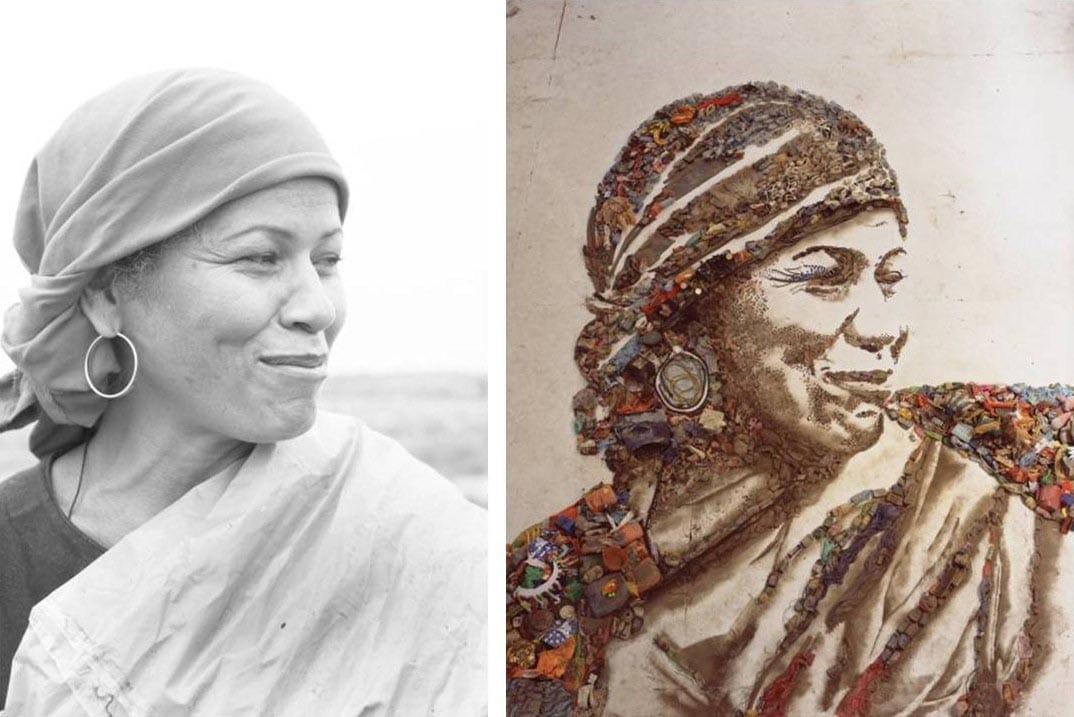
I have never understood modern art, it has never made any sense to me.  But after watching the documentary “Waste Land” I now have a new appreciation for what it can represent.  In this documentary artist Vik Moniz transformed the lives of the “catadores”(pickers of recyclable materials)  of the world’s largest landfill, Jarim Gramacho, by making them the objects of his artwork. 

For the first part of the documentary all I felt was shock at the conditions that these people  live in.  They are the poorest of the poor and most of them have experienced hardships in their lives that I even imagine.  For the most part they were all trying to be positive but there was a sadness and despair behind their eyes that they couldn’t hide.  But as Vik involved them in his work all that started to change.  Being a part of Vik’s project gave them an opportunity to feel important and needed, something that every human being wants to feel.  But this project didn’t just help them spiritually, it helped them physically.  All of the money from the sale of the artwork was given back to the catadores of Jarim Gramacho.  Although the landfill was closed in 2012, the resilient spirit of the catadores lives on through the ACAMJG(Association of Recycling Pickers of Jarim Gramacho) and the people that are a part of it. 

I was inspired by Vik Moniz in this documentary because he took a talent he already possessed and used it to help others.  His actions inspired me to try to find ways to use my talents to help others as well. 

I know I haven’t done much to describe the nature of the actual art created, but it is literally too beautiful to be put in words.  If you would like to know more about the documentary “Waste Land” you can watch the trailer here: http://wastelandmovie.com/index.html


Picture source:
http://www.boumbang.com/wp-content/uploads/2012/05/Vik-Muniz-27.jpg